
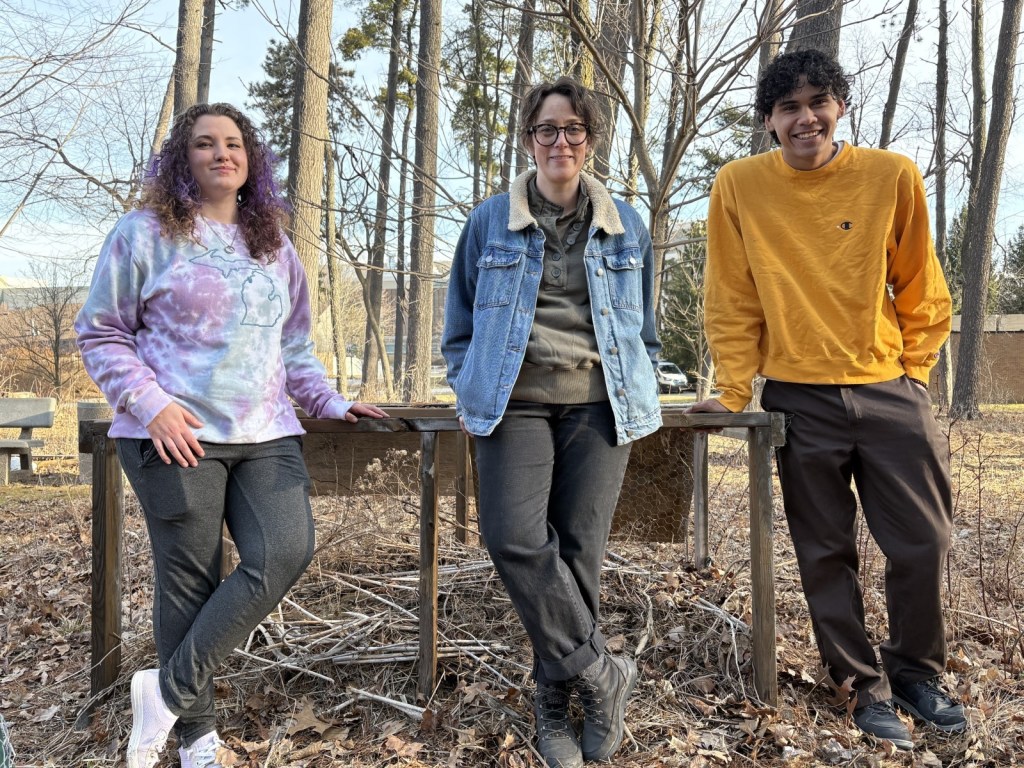
Photo Legend: CSR Work Study Students in front of Food Forest Open bin composter.
Photo credit: Emily Thompson
By Sarah Lahey
April 16, 2025
So, what is composting? Known by farmers as “black gold”, composting is a natural process of recycling organic matter that’s transformed into a nutrient-rich fertilizer that can be used for gardening, horticulture, and agriculture. Any organic material will eventually decompose, but with composting the process is sped up to create the ideal environment for decomposing organisms (such as worms, bacteria, and fungi).
There are many benefits to composting, such as: reducing the waste stream, cutting methane emissions, improving soil health and lessening erosion, conserving water, and reducing personal food waste.
How to Compost
Composting can be processed at the industrial scale, in smaller scale community systems, anaerobic digesters, and at home. When composting at home, there are several factors that can determine how you’d like to compost. Things like where you live and the availability of space, how much and what kind of organic waste you produce, and how much time you have. There are several different ways to compost at home. My personal preference and recommendations are an open bin or a tumbler.
An open bin can be sectioned off with fencing wire or just a pile on the ground, usually a 3 ft x 3 ft area will do. While you’ll have easier access to the material, there is no way to prevent critters and insects from accessing it too. This is an ideal way to compost yard waste and is low maintenance. Some DIY options include using wooden pallets or metal or wood posts wrapped in fencing wire.
A tumbler bin is a sealed container that is mounted so it can be rotated by a handle. The easy rotation aerates and mixes which speeds up the decomposing process. Tumbler bins usually have built in air vents to provide airflow. If it does not, caution is needed to ensure it doesn’t get too wet inside; as it will retain both heat and moisture. It is common to have finished compost within two to three months with ideal conditions. Tumbler bins can be purchased online or at most garden or hardware stores.
Worm composting (vermicomposting) is another great way that you can compost indoors and year-round. Check out this video from Becky Andrews, Recycle Operations Manager, at WCC. MSU also has a great overview and tutorial on building your own vermicompost.
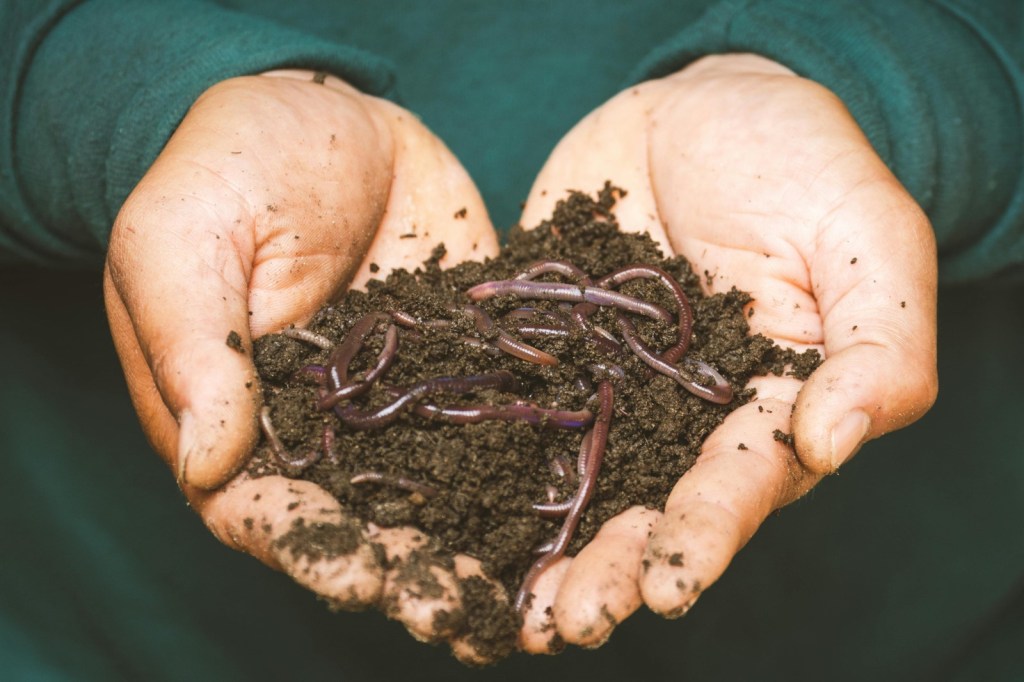
Photo: Handful of compost and earthworms
Photo credit: Yamkasikorn, S. (2020) Earthworms on Persons Hand. https://www.pexels.com/photo/earthworms-on-a-persons-hand-3696170/.
Compost Ingredients
Four basic ingredients are needed for decomposing organisms: carbon, nitrogen, air, and water. Compostable material already has carbon, with traces of nitrogen. What’s needed is creating the ideal ratio. A ratio using two to four parts “brown” material for every 1 parts “green” material is considered ideal. A pile that is too carbon rich will be dry and slow to decompose, while a nitrogen-rich will create a slimy wet pile that can be smelly.
Nitrogen rich “greens” consist of fruit and vegetable scraps, coffee grounds, tea bags, grass clippings, and flower petals. Carbon rich “browns” are dry leaves, shredded paper, cardboard, twigs, and wood chips. While some things that should not be composted are meat, fish, bones, dairy products, plastic, treated wood, diseased plant material and egg shells.
Compost Ready to Use?
Mature compost should be dark brown almost black with a crumbly soil consistency. Use a sifter, such as chicken wire, to remove larger unprocessed pieces. To enrich your soil apply 2-3 inches of compost and mix into the top layer, alternatively you can apply a layer of compost before adding mulch. You can also make compost tea to fertilize your vegetable garden and indoor house plants.
Things You Can DO with your “Black Gold”:
- Visit a compost at the WCC Food Forest or Growing Hope!
- Try open bin composting, tumbler composting, or vermicomposting!
- Use your compost for gardening and houseplants and enjoy saving money!
References:
Becky Andrews | WCC Vermicomposting
Emily Thompson | WCC Food Forest
 Center for Sustainability and Resilience at WCC
Leave a comment